

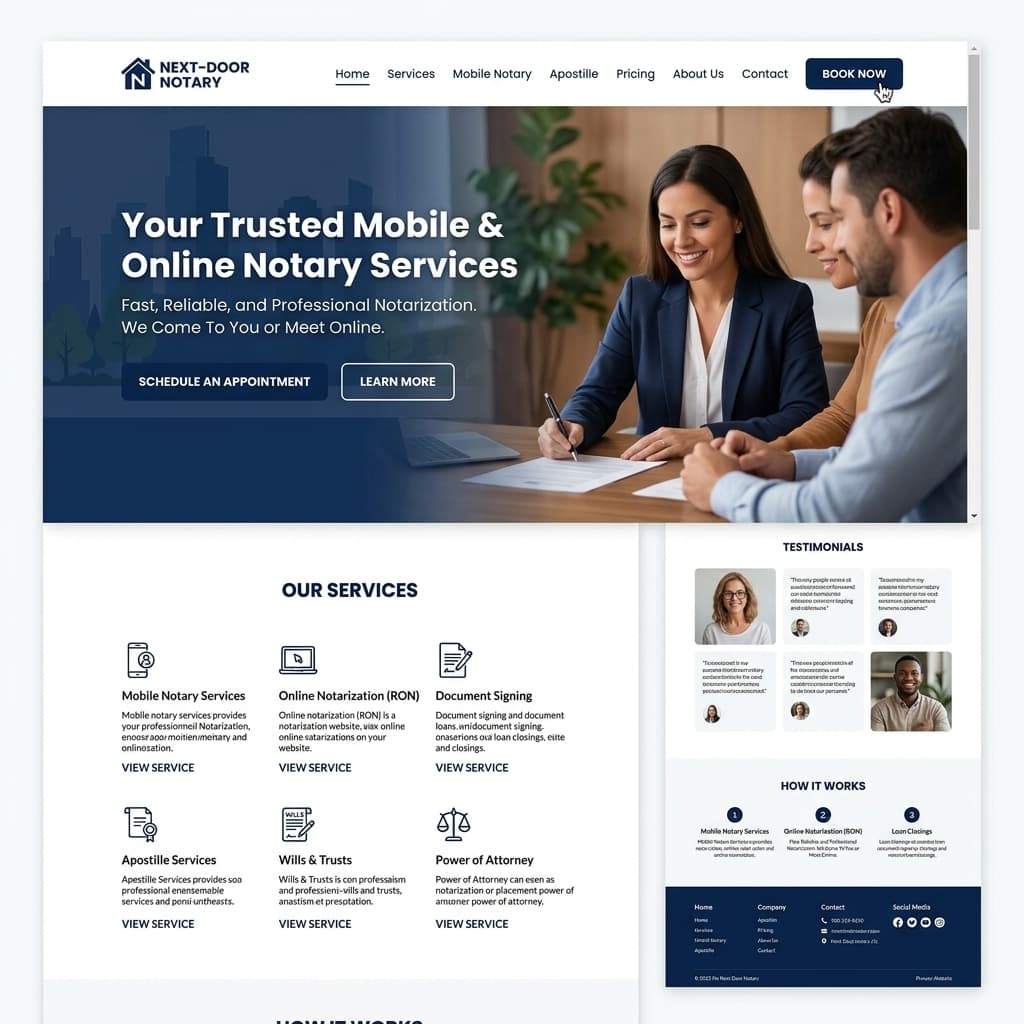
Next-Door Notary needed a single platform to handle scheduling, document workflows, and payments across the entire state of Oklahoma. Here's how we turned a fragmented manual process into a seamless, mobile-first product.
The Challenge
Notary services in Oklahoma were largely run over phone calls and paper forms. Clients struggled to find available notaries, book appointments, and submit documents securely.
Our client wanted a platform that could scale across regions, handle real-time availability, and keep sensitive documents safe — all while feeling effortless on a phone.
Our Approach
We started with a discovery sprint to map every step of the notary journey, from search to signed document. This shaped a booking engine built around real-time availability and timezone-aware scheduling.
A React front-end paired with a Node.js API gave us the speed and flexibility to iterate quickly, while a document vault with role-based access kept everything compliant and secure.
The Result
Within three months of launch, the platform processed thousands of bookings with zero scheduling conflicts. The mobile-first design meant most users completed their booking in under two minutes.
Written by
Agniva Das
Founder & CEO, Aprodence